

The Romantic Aperture
A very brief pet-hypothesis about an erotic origin of language.

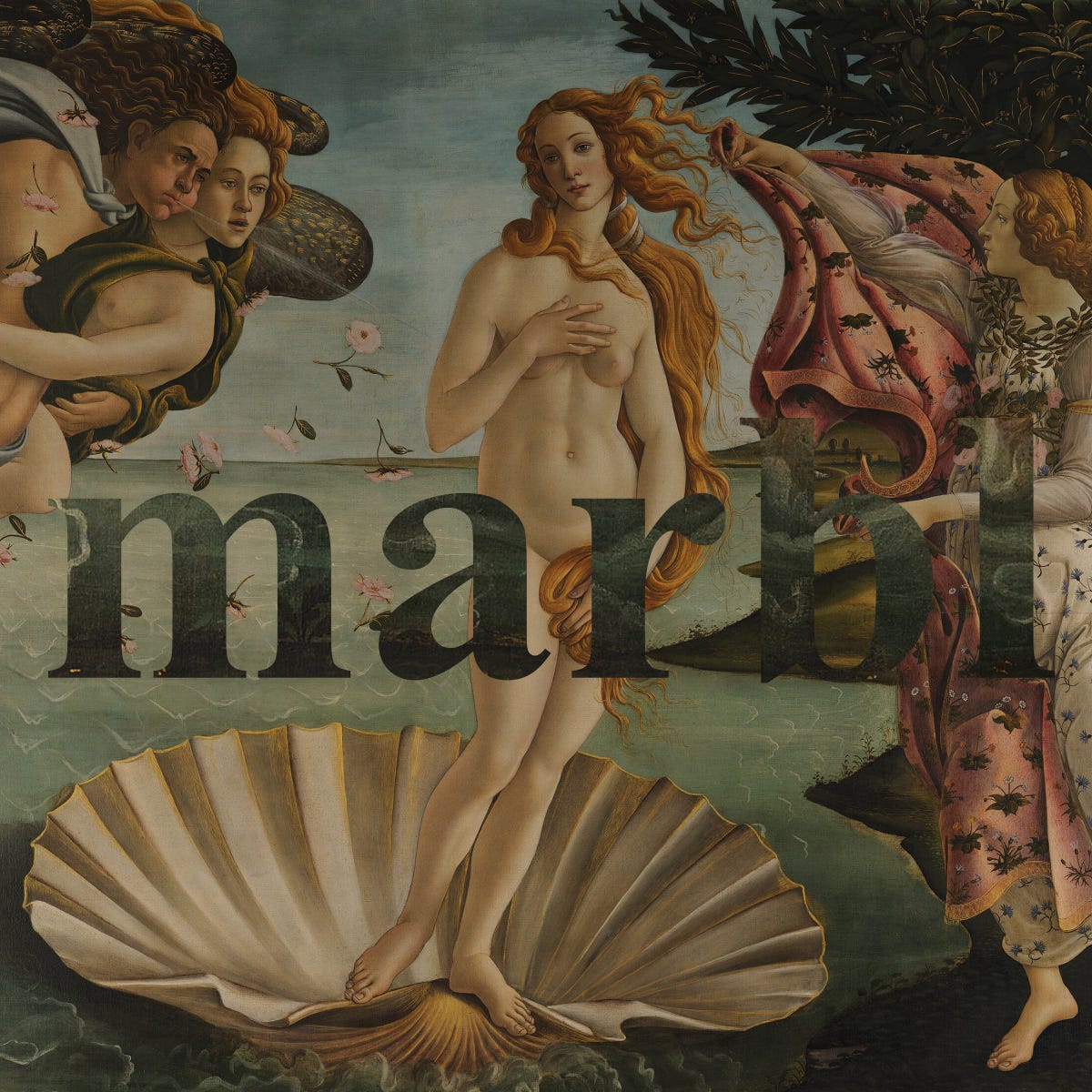
In semiotics the basic unit of syntax is the phoneme1. However in semantics the basic unit of meaning is the image. Syntax has no reason for its rhyme except to evoke and make re-present the image. All of the Odyssey performed in, at most, 46 phonemes (attic Greek)—to later be written down in 24 graphemes. I love Herder2 because he understood language as something intrinsically human, not the progress of a complicated mammal, and yet neither our invention, but constitutional to the cognition and subjectivity that separates us from animals. The knife that cuts itself away. But the idea that Man became man when he heard the bleating of a sheep always struck me as foolish.
First of all who could care that much about sheep, minor point but still.
Secondly, we require joint attention to enact language acquisition and joint attention has a tripod structure: subject experiences object with and by another subject, language is first dialogical and not monological. It fails to recognise that minds are initiated into language via other linguistic minds. In this way, the problem of the origin of language presents itself much like the problem of the origin of life. The interesting thing about life, is that unlike our information machines, the handling of information via subcellular processes, demonstrates a type of computation where the software is the hardware, and meaning is in constant flux AS matter-energy-information—information is soma and significant (Bohm), which is to say constitutive.
I feel very strongly that the birth of language has to come at the place where both syntax and semantics collide inside of a tripod structure of joint attention—where the ratio between phoneme and image is 1:1 and the relation between subject-object-subject also collapses to one. And I feel a sustained conviction that this can only occur during sex. In the concurrence of orgasm, I try to feel what you feel while you conversely try to feel what I feel, and the thing we use to mark alignment are vocalizations; Phoneme and image, subject and subject as shared object, successful love making uses moaning to try and to turn the Venn diagram of separate sensation into a circle. An attempt to grasp the Bergsonian flux of state, and offer it to another. I and Thou; US as the first medium and message.
Suddenly, metaphor. That following a garden of forking paths strikes a peace in two worlds—the merging of two paths (see Borges and Hafez).
The problem with the idea that some hominid heard a sheep bleat, and recognized it as an object in the vast “ocean of sensations” and had the epiphany that the sound could represent the sheep is one leap. But how does that hominid transmit language to the rest of the hominids? The contagion of language makes no sense in Herders’ scenario. But if the recognition point occurs through love-making the method of initiating others into the linguistic capacity is quite obvious. You make love to them. In making love to them, you attempt to vowel what you feel they feel. You make a primordial music; proto-poetry. You could inculcate not a language, but the linguistic faculty into whole tribes of people through ritualized sex magic, later on, much later on you could cast spells upon them, as I am doing here, by transcribing those phonemes further into written symbols: spelling.
Lacanian psycho-analysis has taught us that sex is negatively constitutive of the human psyche. That the sexual, neither thing nor action, is actually a structuring short-circuit in human nature. Again the metaphor and the literal are at a 1:1 ratio when we recall the work of Reich in relation to the orgasm as a bioelectrical short circuit—two streams of energy meet and superimpose—a discharge that requires first a tension. Here for reality to be something legible to conscious human cognition it gets sort of bent around the sexual itself, as the pull of the unconscious. What is sexual, “is coextensive with the emergence of the subject.” (see Zupančič, What is Sex) In the same way that language is not something that the human subject does but rather constitutive of what makes it so. If we moan for what we want, then whereof we want not moan we thus speak naught. We do not look at a world, but look for what we desire. Phenomenology tells us that perception is emotional, embodied, and attention is intentional, motile. While psychology tells us that all that what appears as the self stands atop forgotten pillars of the shadowed unconscious of what that self is lacking, is wanting.
I could imagine that a practice of Sex that fundamentally changed and thus founded human self-reflexive cognition, would also, after its emergence, be found to function as a kind of black hole in that cognition. Sexuality arises not out of the genitals, but actually out of the mind, perhaps more rightly out of the face; the voice, the gaze, the inter-facial bind (see Sloterdijk). Two mirrors pointed towards one another is the sudden appearance of infinity, but at the cost of the finite view of whatever that mirror obstructs.
Many Cosmogonies begin with the love between a primeval coupling and copulating of sky and earth: Gaia and Uranus in Hesiod’s Theogony; An and Ki in ancient Sumer; Rangi and Papa in Maori mythology; Nut and Geb in ancient Egypt. Before Adam and eve ate from the tree of knowledge there was no recognition of nakedness. All center the creation of the world upon sex and their separation. The paradox of sexuality is the eroticism of distance. The knife which dissects the world, also forms bridges across the voids it cuts. That as Thoreau puts it, “I have found that no exertion of the legs can bring two minds much nearer to one another.” What sex could not complete, only language could.
![Il dépend d'un point de regard invisible, étant donné la nature même du regard - Voyage au pays de l'autre côté [Autour de Marcel Duchamp] - II - Reflexiones sobre "Étant Donnés" -](https://substackcdn.com/image/fetch/$s_!iAMv!,f_auto,q_auto:good,fl_progressive:steep/https%3A%2F%2Fsubstack-post-media.s3.amazonaws.com%2Fpublic%2Fimages%2Ff3fba337-878b-4e95-89de-0ddfe64bf779_202x249.jpeg "Il dépend d'un point de regard invisible, étant donné la nature même du regard - Voyage au pays de l'autre côté [Autour de Marcel Duchamp] - II - Reflexiones sobre \"Étant Donnés\" -")
Étant donnés, Duchamp
Not strictly true, but stay with me.
An interesting pet theory (a 'petting' theory?). I have been thinking through the invention of language as the true conception of humanity as separate from the rest of creation, i.e. the fact that Adam and Eve were given the ability to name the animals right at the beginning seems key.
Your thought experiment as to what would lead to humans needing language for the purpose of inter-human dialogue is fascinating and compelling, though I'm not sure I'm convinced that sex requires the kind of linguistic communication we're dealing with here. Animals have sex without the need for it.
Instead, I would expect we will find the conception of language in the actions that differentiate us from the beasts, in works that require mutual participation for mutual benefit -- think hunting and gathering and then distributing, think midwifery, think burial of the dead.
But maybe I'm off base?
gr8