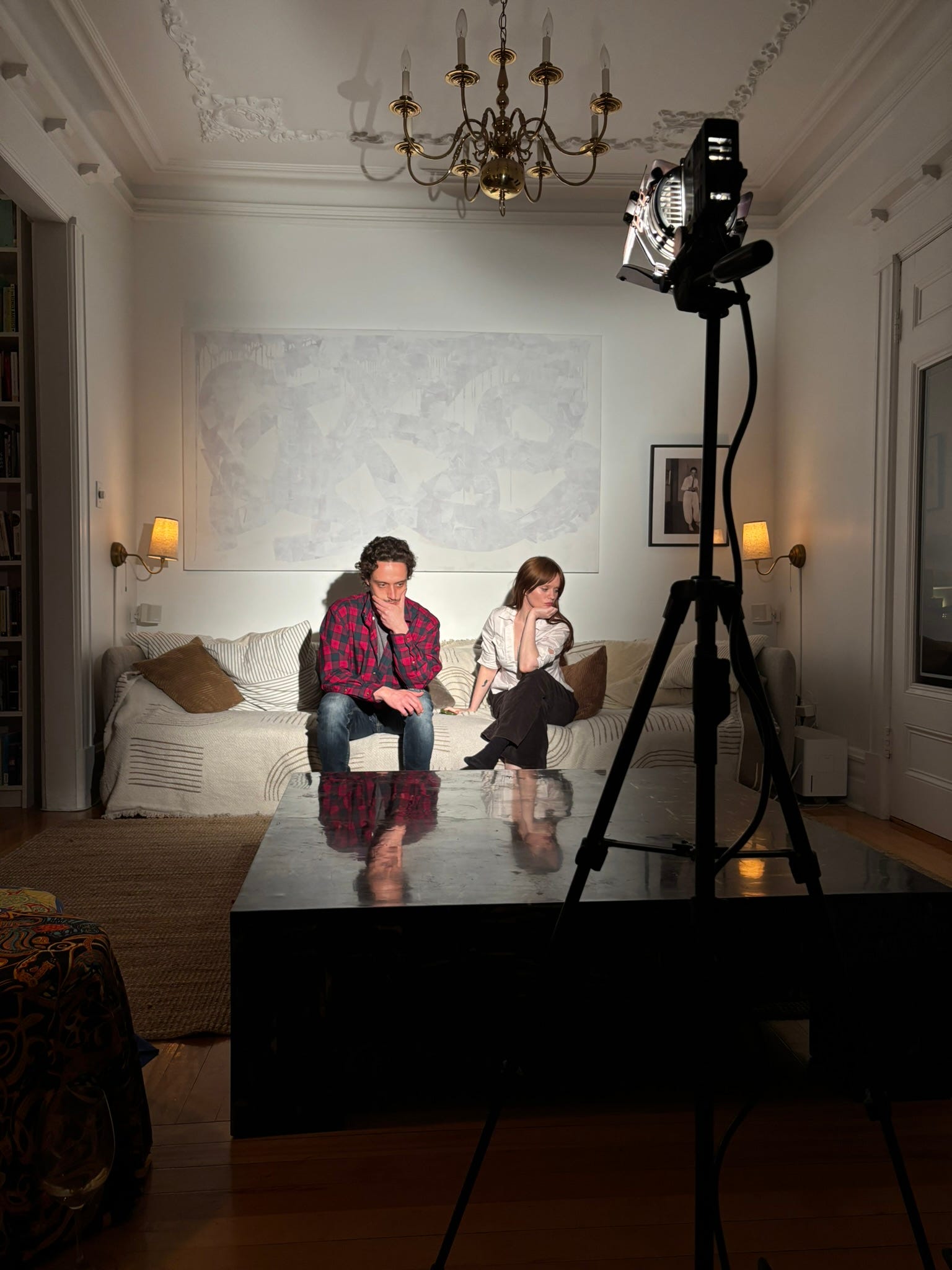
A Few Thoughts on Over the Moon
A Director's Note for Matthew Gasda's Neo-Romantic Play

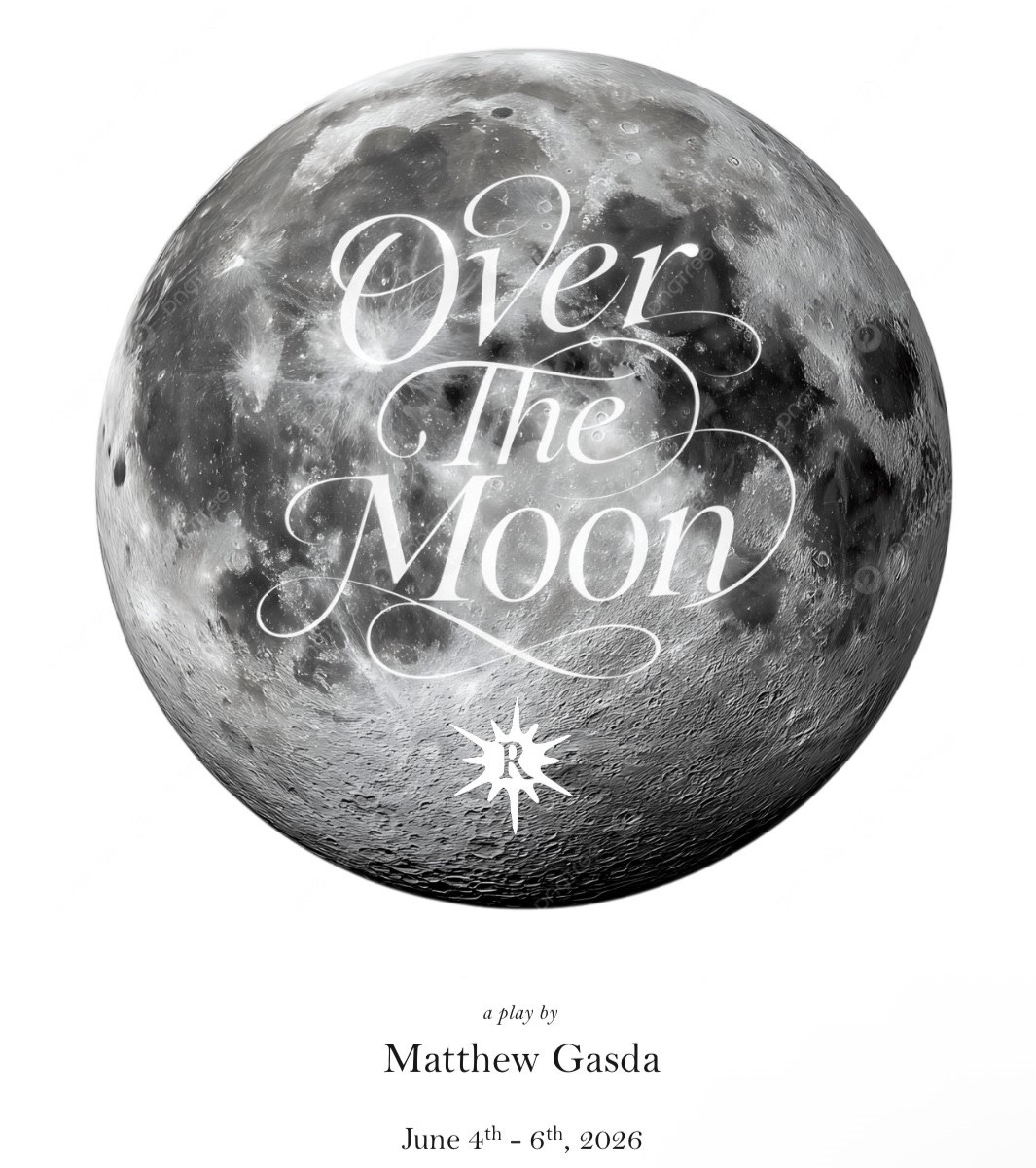
If you have noticed my absence here it has been mainly because I have spent the last few months working on a little collaboration with my Romanticon co-editor, Matthew Gasda, producing a staging of his play, Over the Moon, in Montréal. It’s the first time one of his plays will be performed in Canada and as Matt winds down his theatre in New York, it may be a rare opportunity to see one of his plays for a while.
What follows are a few of my thoughts on theatre and the play. Enjoy!
Opening Night is this Thursday,
at Studio CUERO, you can grab tickets here.
When I first moved to Montreal I didn’t know anyone. I was in a really hard place in my life and moving somewhere without any friends, where I didn’t speak the language, really wasn’t helping me. The first person I did meet was at the Humble Lion Café. He asked me what I was reading, we chatted briefly about the book—The World Through Blunted Sight; a funny history of artists with myopia—and when we parted he invited me to a theatre performance later that week. He was an actor, a part of a theatre troupe at McGill.
When I showed up later to see the performance, I recalled having had an especially hard day; I spent a lot of my days quite difficultly alone in those first six months. But that first evening was a performance of A Midsummer Night’s Dream (Ben played Puck). I laughed and cried, and it was in such stark contrast the apathy I’d unwillingly fallen into. The group invited me to the after party and these became some of my first friends during that otherwise very cold winter.
At their performances, I felt elated, I felt re-gravified, like my current predicament was just a phase but that my experience still had meaning. I think about that often; Jodorowsky once said:
One does not go to the theater to escape from himself, but to reestablish contact with the mystery that we all are.
As of today, I have spent the spring directing this performance. When Matthew initially asked me to direct a staging in Montréal, I don’t think I would have had the real motivation to work on this if it hadn’t been for those first friends I made here.
Today’s psychological-industrial-complex tells us that the utility of art is self-expression. Post-modernisms tells us the meaning of art is valuelessly subjective. But if this were truly the case would I be here changing the course of my life just to bring it to the attention of others? You either know you’re being actively changed by a work of art or you’re not. This is subjective but it is not valueless; it’s expressive but it’s not selfish.
Matthew understands the current moment in a way that is intimately tied to how people interact, how relationships operate right now. He uses relationships as the vessel through which a kind of perennial wisdom gets extracted out of and administered into contemporary life—so that ordinary exchanges become sites where something older can take hold. And I’ve found its utility to be a way of reading my own life, and I hope that it can do the same for our upcoming audience.
I read a lot, but I almost never re-read.
But in order to direct a play you become extremely well acquainted with one single text. I’ve read Matt’s script probably 50 times by now. Although I’m quite accustomed to his writing already, I knew from the first read that this was a special script. The whole play takes place in a kind of claustrophobic apartment, over two days and two nights during a late January Wolf Moon. It is a series of intense dialogues, typically between two interlocutors, all lying somewhere between a heart-to-heart and a tête-à-tête. Quickly one realizes that none of the characters are particularly admirable. They are all just kind of crammed together in life as in the play’s apartment setting, and often rubbing up against one another in abrasive ways.
Reading and rereading the script I’ve found a lot of medicine in their back and forths.
Gasda, it is said, is a realist playwright. His dialogue is quick and often discontinuous, it has the texture and irrationality of real conversation. Often characters are just talking over one another without even really listening; People space out on their phones, thoughts build and swell and then just like that, topics change; Loose threads of conversation fray around coherent and strong emotional states. The play is almost entirely dialogue and yet the dialogue is only there to point at something else, and that something is exactly what the play is about: A dark spot in the sky, just above and beyond the moon, with its ghostly cold light, a reflected or rather deflected light.
The play shows us the way that no one says what they really need to say. No one can talk explicitly about the things that are driving their behaviors. No one can look directly at the sun—at death, or at love, or at sex, or at cheating—so instead they look at the full moon’s light. Instead, the real subject matter of our lives gets filtered through something else, vague unfinished reactions, social media, analysis, affairs, false declarations of love, episodes of Sex and the City, songs, and fights about nothing.
The title of this very American play makes me think of this one Tragically Hip song:
Say those little things that don’t make anyone feel better.—The Sun’s a lightbulb and the moon is a mirror. There are times when you can see both the bulb and the mirror, see the bulb in the mirror.
I read and reread this handful of conversations and every time I find something a little deeper, another lie, another avoidance, another deflection. And then occasionally a few glimpses when the characters actually open up; the way the clouds can suddenly part, or the curtains open and there it is, the light of the sun, distant, cratered, and diffused but nonetheless bright. The love that lurks behind all the layers of misdirection, all the tedious ways we fail to hold our relationships sacred. The light that we reflect off so much trouble, only because we can’t bear to stare at it directly.
In the last scene of the play, our two protagonists sit together, for the first time, in their new apartment. Eden plays with the little mirror, a gift from their new neighbor:
[She plays with it, reflecting the sunlight through the windows.]
Reads the script notes. And the play finishes with the lines:
CODY
Don’t look at me like that, you’re gonna make me cry.
EDEN
Where should I look?
[Cody hands her the mirror.]
The play asks us to look not at the characters we play, but at ourselves, the light in the mirror.
Behind my work on the play I too have a 21st century life. I have loadbearing relationships which struggle to find reciprocity. I have hurts, and doubts, and fears about them that I don’t speak out loud. And directing this play has forced me to ask myself: If no one in my life is willing to hit the nail on the head, including myself, how do I reflect a bit of light off these conversations? How do I keep myself from playing along with all the lame concerns that we are supposed to entertain? I’m not sure I’ve developed any skill around the issue, but the play has at least given me a bit more awareness about it: I want to be the Ezra of my family and friends. I don’t want to stop until I’ve hit a vein and the truth is gushing out of us like oil.